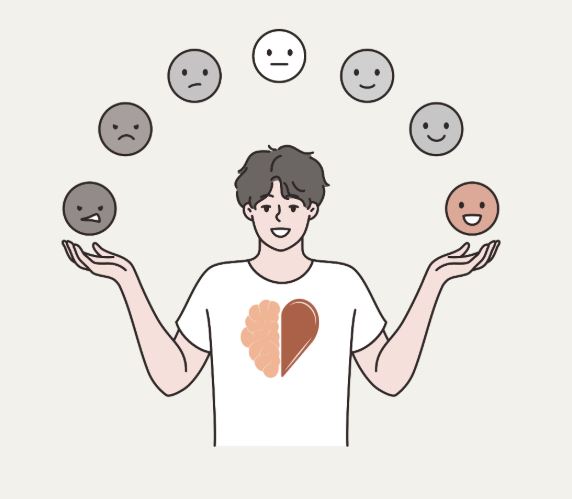
What are emotions, really?
Nobody teaches us what emotions actually are.
Emotions aren't abstract concepts or thoughts to manage—they're physical sensations in your body.
That one piece of understanding changes everything.
Emotional Health vs. Mental Health
We talk a lot about mental health—and that's important. But we rarely talk about emotional health.
Mental health is about your thoughts, your cognition, your ability to process information and make decisions.
Emotional health is about your body's ability to feel, process, and release the physical sensations that come with those thoughts.

Here's a simple way to think about it: We question thoughts. We feel feelings.
Our mental and emotional health are deeply related. Different thoughts create different sensations in your body. It's a back-and-forth movement: mind to body, body to mind, mind to body, body to mind.
But if we only focus on the mental facet—on our thoughts—we're missing something major. We also have to tune into how those thoughts are being physically experienced in the body.
Sensations are the language of emotions. And when we're not taught to speak that language, we're not as connected. Connection is the whole point: connected to ourselves, connected to each other, connected to something bigger than ourselves.
So What Are Emotions, Really?
Emotions create a physiological response in your body. They're sensations you can actually feel.
Let's take anxiety as an example:
When you're anxious, you might feel:
A knot in your belly
Sweaty palms
Your heartbeat increasing
Tightness in your chest
This is why anxious kids often complain of headaches and bellyaches. It's not that they're "making it up"—their anxiety is creating physical symptoms. This is psychosomatic: the gut-brain connection is real, and unprocessed anxiety shows up in the body.
Emotions also have different weights and textures:
Some emotions are heavy, like grief and shame. They pull you down. You want to lie down, curl up, move slowly.
Light emotions like joy and excitement feel bouncy, buoyant. You want to move, jump, express outwardly.
These aren't just symptoms of emotions. These are the emotions. Your body responding to what's happening.
We have emotions for survival, for decision making, for social bonding, and for learning.
What Nobody Taught Us
Most of us learned to identify emotions: "I feel angry." "I feel sad." "I feel anxious."
But we were never taught:
Where those emotions live in our bodies
That emotions are meant to move through us, not get stuck in us
How to actually feel them instead of just thinking about them
What happens when we push them down or ignore them
Instead, we learned to manage them. Control them. "Calm down." "Think positive." "Just breathe." Rather than embracing them and allowing them.
All strategies that keep emotions in our heads instead of allowing them to move through our bodies.
What Happens When We Don't Feel Our Emotions
When we don't process emotions in our bodies, they don't just disappear. They get stored. They create chronic stress in our nervous system. And unprocessed emotions, if we don't do something about it, can make us sick. Chronic stress also accelerates our aging.
When you're stuck in a dysregulated state, you tend to either overfunction or underfunction:
Overfunctioning looks like frantically doing ALL the things, constant motion, unable to rest, anxiety driving you forward.
Underfunctioning looks like shutting down, withdrawing, unable to take action, feeling stuck or frozen.
Either way, you're dysregulated. And this shows up as:
Physical tension and pain
Chronic exhaustion and burnout
Anxiety that seems to come from nowhere
Staying stuck in survival mode
But there's something even more painful:
When we don't process emotions, we become disembodied—disconnected from our own internal experience.
You've probably seen this: someone laughing when something is actually sad. Someone saying "I'm fine" while their body tells a different story. This incongruence—when emotional expression doesn't match what's really happening—is a sign that emotions have been pushed down for so long that we've lost accurate perception and expression of what we're actually feeling.
And here's what makes this even more painful: we end up feeling disconnected from other people too.
Our social and emotional health are deeply correlated. When we're off emotionally, we're off socially. When we can't authentically feel and express what's happening inside us, others can't truly connect with us. We end up feeling isolated even in a room full of people.
Why This Matters Now
We have emotions for survival, for decision making, and for social bonding. But here's what many don't realize: emotions are also essential for learning.
Think about it—whenever you have a strong emotion tied to something you're learning, you're going to remember it more. This is why it's so important to have fun in the classroom. When we're emotionally connected to what we're learning, when we have a deep emotional response, we retain it. Without that emotional piece, the learning doesn't stick.
All of those unprocessed emotions create stress in our bodies and our nervous systems. They keep us stuck in managing mode instead of creating mode.
And we can't teach kids something we don't understand ourselves.
What I'm Exploring
I've been developing a 12-lesson social-emotional curriculum for ages 7-11 that teaches this foundational piece: emotions are sensations in your body, and you can learn to feel them, process them, and release them.
I also teach teachers and adults how to regulate their nervous systems to create ripple effects of wellbeing in their classrooms and cultures.
Because here's what I'm realizing: we can't guide kids through something we've never experienced ourselves. We can't teach emotional processing from a place of intellectual understanding alone—we have to embody it first.
What's Next
This is the first post in a series where I'm breaking down what we weren't taught about emotions—and what we desperately need to know.
Next time, I'll share how emotions and stress are connected, and why managing stress without addressing emotions keeps us stuck in survival mode.
If this resonates and you'd like to learn more about bringing this work into your school or organization, I'm looking to pilot my curriculum with schools, educational leaders, and community groups. Feel free to reach out.
I'd love to hear from you:
What can you see now that you couldn't see before? What nuance have you picked up on?


